The Room That Made You Talk: What Actually Gets Strangers to Open Up
You've been there. The trip where you came home with a story about a person — not a landmark, not a restaurant, but a person. The retired schoolteacher at the end of the bar who turned out to know everything about the neighborhood's history. The couple at the communal table who ended up recommending the exact hike you needed. The local at the coffee counter who, for reasons you still can't fully explain, just started talking to you.
And then there are the other trips. The ones where you spent four days surrounded by people and somehow never had a real exchange with a single one of them.
The difference usually isn't you. It's the room.
Permission Is the Invisible Ingredient
Most people don't strike up conversations with strangers because they're afraid of getting it wrong. Not wrong in a dramatic way — just awkward. Intrusive. Unwelcome. That fear keeps a lot of potential conversations from ever happening.
What certain spaces do, almost architecturally, is dissolve that fear. They create what you might call social permission — an ambient sense that talking to the person next to you is not just acceptable, but expected. When that permission is in the air, the barrier drops. You say something. They answer. Something real begins.
The trick is learning to recognize which rooms have it and which ones don't.
Seating Does More Work Than You Think
The single biggest predictor of whether strangers talk isn't personality — it's proximity and orientation. Research on public space design has shown this for decades, but you don't need a study to feel it.
A long communal table at a brewery forces you into side-by-side or face-to-face contact with people you didn't choose. A row of individual two-tops facing a wall does the opposite. One arrangement makes conversation the path of least resistance. The other makes it feel like an interruption.
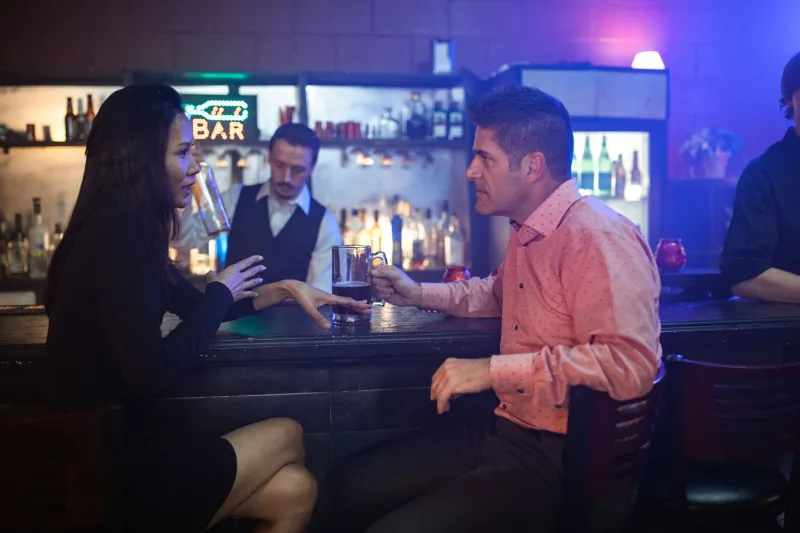
Counter seating — the kind you find at old-school diners, sushi bars, ramen spots, and classic American lunch counters — is especially powerful. You're all facing the same direction, which removes the intensity of direct eye contact while still keeping you within easy speaking distance. It's not confrontational. It's companionable. The counter at a place like that has probably started more friendships than most dating apps.
When you're choosing where to sit, choose toward people. The corner table is comfortable. The stool at the bar is where things happen.
Lighting Sets the Emotional Temperature
This sounds like interior design talk, but bear with it. Bright, overhead fluorescent lighting signals efficiency. It says: get in, get out, don't linger. You feel it in fast food restaurants and airport terminals — spaces designed to move people through, not hold them.
Dimmer, warmer lighting does something different to the nervous system. It slows people down. It signals that the space is for staying, not just passing through. And when people stay, they relax. When they relax, they talk.
This is why dive bars with bad bulbs and candle-lit wine spots both punch above their weight as places where strangers connect. The ambiance isn't just aesthetic — it's functional. It tells your body it's okay to settle in.
When you're scoping out a new spot in an unfamiliar city, pay attention to how the light feels when you walk in. If it makes you want to sit down and stay awhile, you're probably in a place where other people feel the same way.
Shared Rituals Create Shared Identity
Some venues have built-in activities or rituals that give strangers a reason to interact without anyone having to manufacture one from scratch. Trivia nights. Communal card games left out on the table. A dartboard that requires you to ask if someone wants to play. A menu written on a chalkboard that everyone has to squint at together.
These aren't gimmicks — they're conversation infrastructure. They give you something to do together before you figure out whether you want to talk together. That sequencing matters. Shared activity lowers the social stakes. You're not asking someone to open up; you're just asking if they want to take a turn.
Farmers markets work this way. So do bowling alleys, bocce courts, and any bar with a good jukebox where people actually argue about what to play next. The activity is the excuse. The conversation is what happens after.
When you travel, look for places with built-in shared rituals. They're doing the hard work of connection for you.
The Regular as a Social Anchor
Here's something that doesn't get talked about enough: a room full of strangers is actually harder to crack than a room with a few regulars in it. Regulars set the social tone. They model what's acceptable. If they're warm and chatty, the room tends to follow. If they're heads-down and territorial, everyone else takes the cue.
One engaged regular at the end of the bar is worth more to a traveler than a whole happy hour crowd of tourists. That person knows the bartender by name, knows the neighborhood, knows the history of the spot. They're a living portal into the place you're trying to understand. And because they're there — not passing through — they're often more willing to talk than you'd expect. Locals who love their spots tend to enjoy sharing them.
The move here is to find the person who looks most at home and let the conversation come naturally. Don't rush it. Order what they're having. Ask about something on the menu. Let it unfold.
You Can Set the Conditions Yourself
Here's the part that most people miss: you're not just a passive receiver of whatever social environment a place happens to have. You can nudge the conditions in your direction.
Put your phone away. Not just face-down — actually away. A phone on the table is a signal to everyone around you that you have somewhere else to be. Removing it signals the opposite.
Make eye contact with the person behind the bar or counter. Not aggressively — just enough to register as a human being who's paying attention. That small act opens more doors than any opening line.
Sit at the bar instead of a table. Order something that invites a question — the special, the local draft, whatever the person next to you is having. Ask about it. Mean it.
These aren't tricks. They're just behaviors that communicate openness. And when you communicate openness in a space that already has permission built into it, the math gets very favorable very fast.
The Place Is Doing Half the Work
The best travel connections aren't the result of being unusually charming or socially fearless. They're the result of being in the right room at the right time — and knowing enough to recognize it when you're there.
Meet in Place is built on exactly this idea: that connection happens in specific places, under specific conditions, and that finding those places is a skill worth developing. The spot matters. The setup matters. And once you learn to read a room for its social potential, you'll stop leaving those conversations to chance.
The next stranger you actually talk to on a trip? The room probably helped.