Strangers Who Keep Showing Up: The Accidental Communities Inside the World's Most Visited Places
There's a bench outside the Uffizi Gallery in Florence that has, at any given moment, a rotating cast of people who absolutely did not plan to become friends. A retired couple from Ohio who've been to Italy four times. A solo backpacker from Portland killing time before her next train. Two guys from Chicago who met in line forty minutes ago and are now deep into an argument about whether the line is even worth it. Nobody recruited them. Nobody scheduled a meetup. And yet, something is happening on that bench that looks a lot like community.
This is the part of travel writing that tends to get skipped over. We spend a lot of time talking about escaping tourist traps, finding the real version of a city, connecting with locals in their natural habitat. All of that is worth pursuing. But somewhere along the way, we started treating tourist hotspots like social dead zones — places where real connection goes to die under the weight of selfie sticks and audio tour headsets.
That's not the whole story.
The Churn That Somehow Sticks
Here's the strange thing about places that see thousands of visitors a day: the turnover is so high that the social dynamics get compressed. You don't have weeks to warm up to someone. You have an hour in line, or a shared table at an overpriced café, or fifteen minutes under the same awning waiting out a rainstorm. The usual social timeline collapses, and people — freed from the slow rituals of ordinary life — skip straight to the interesting part.
Ask anyone who's done a long multi-day hike, or spent a week at a major international festival, and they'll describe the same phenomenon. The intensity of a shared, time-limited experience accelerates connection in ways that months of living in the same apartment building often can't. Tourist hotspots work on a similar principle, just concentrated into tighter windows.
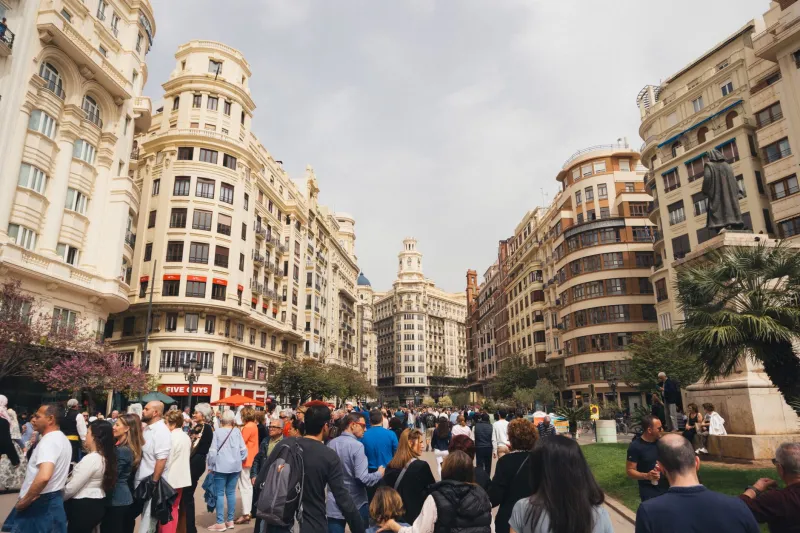
The difference is that at a trail or a festival, there's a built-in expectation of togetherness. At the Louvre or Times Square or the Grand Canyon's South Rim, you're technically just a crowd of strangers all trying to see the same thing. The community that forms there isn't by design. It's accidental. And accidental, it turns out, can be surprisingly durable.
When the Transient Becomes the Identity
Some places have leaned so hard into visitor culture that the visitors are the culture. The Spanish Steps in Rome. The High Line in New York. Pike Place Market in Seattle. These spots weren't built to be social hubs in the traditional sense — they're landmarks, attractions, destinations on a checklist. But spend a few hours at any of them and you start to notice something: there are people there who are clearly not in a hurry to leave.
They've found a spot. They're watching. They're talking to whoever sits down next to them. They came as tourists but they're behaving like regulars, even if "regular" means they show up once every three years when they visit the city.
And here's the question worth sitting with: does that make it less real?
The traditional definition of a local haunt depends on repetition — the same faces, the same orders, the same corner booth on Tuesday nights. That kind of regularity builds something genuine and earned. But it also requires proximity. Most of us don't live within walking distance of the places that matter most to us. We visit. We return when we can. We pick up where we left off.
In that sense, the tourist who's been coming to the same market stall at Faneuil Hall every summer for ten years has a relationship with that place. It's just a different kind of relationship than the fishmonger across the street who eats lunch there every day. Neither one is fake.
The Social Infrastructure Nobody Designed
What makes certain tourist-heavy spots more socially alive than others isn't usually the attraction itself — it's the infrastructure that builds up around waiting, resting, and lingering. Long lines create forced proximity. Outdoor seating without reservations creates spontaneous tablemates. Spots with no clear "right way" to use them — a plaza, a waterfront, a park path — give people permission to slow down and look around.
Central Park is a useful example. On any given Saturday, it's full of tourists. It's also full of New Yorkers who treat it as their backyard. The line between visitor and local blurs completely, and in that blur, something interesting happens: the social norms stop belonging to either group. The space develops its own etiquette, its own rhythms, its own unspoken rules that everyone seems to absorb within about twenty minutes of arriving.
That's a kind of community. It's not a neighborhood bar with a loyal clientele. But it's not nothing, either.
What You Lose and What You Gain
It's fair to acknowledge the tradeoffs. The connections made in these spaces are often short. You might have a genuinely great conversation with someone at the rim of the Grand Canyon and never see them again. The depth that comes from knowing someone over years — from being a real regular at a real local place — isn't easily replicated in a two-hour overlap at a crowded attraction.
But there's something the tourist hotspot offers that the beloved neighborhood dive bar can't always match: access. These places are, almost by definition, open to everyone. No insider knowledge required. No social audition to pass. You show up, and you're already in the mix.
For solo travelers especially, or for anyone arriving in a city without a built-in social network, that openness is more valuable than it sounds. The famous spot is famous partly because it works as a gathering point. People go there because other people go there. That circularity, usually mocked as a sign of inauthenticity, is actually just the oldest social logic in the world: go where the people are.
Finding Your People in the Obvious Place
Meet in Place exists because connection doesn't always require a treasure map. Sometimes it requires showing up somewhere that everyone already knows about and actually paying attention to who's there with you.
The tourist trap, when you stop sneering at it, is sometimes just a place that figured out how to gather people. The community that forms inside it — unplanned, rotating, made up of strangers passing through on their own separate journeys — is messier and less poetic than the image of the wise local and the curious traveler bonding over an unmarked door. But it's real. And on the right afternoon, at the right bench, it might be exactly what you were looking for without knowing it.